
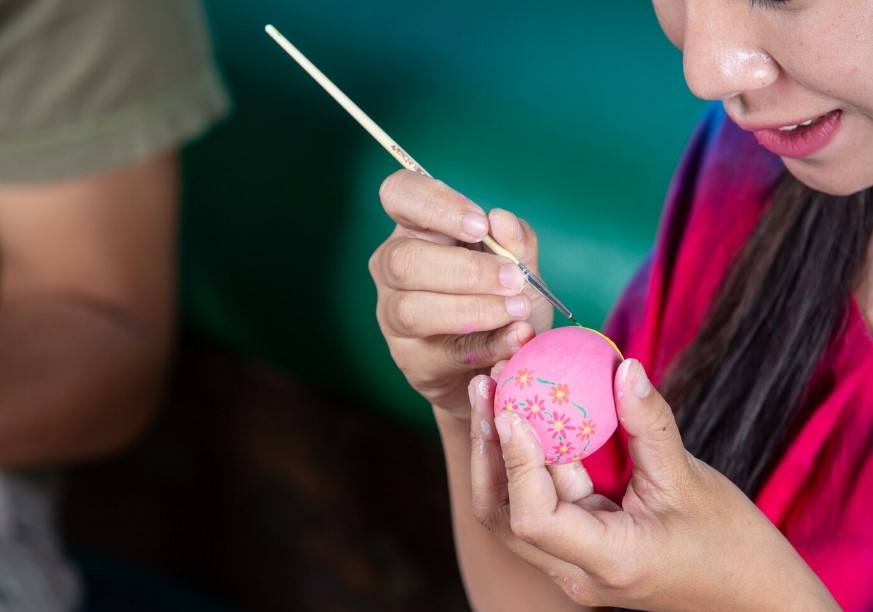
A common approach to explore colours, textures, and ornamental finishes is via handmade crafts. The choice of materials may have a big impact on the finished product, whether one likes to make jewellery, decorate home goods, or make personalised presents. Mica has drawn interest among the many colouring possibilities due to its capacity to create shimmering effects and appealing finishes. Because of its adaptability, artisans may experiment with various methods and give their works a unique touch.
Recognising Mica Powder’s Creative Potential
The mineral mica is well-known for its ability to reflect light. It may provide metallic, pearlescent, or shimmering characteristics when processed into tiny particles and mixed with appropriate pigments or coatings. These powders come in a variety of colours, from delicate pastels to deep metallic hues, depending on the formulation.
Mica powder capacity to interact with light is one of the reasons it is often utilised in handcrafted crafts. Mica pigments have the ability to enhance visual depth and dimension, in contrast to regular colouring ingredients that produce a flat look. The base material, pigment concentration, and application method all affect the outcome. Because of its adaptability, it may be used by both novice and seasoned artists who want to experiment with decoration.
Using Resin Art To Create Decorative Effects
One of the most common uses for mica pigments is resin making. These powders are often used by artists to make vibrant coasters, jewellery, ornamental trays, and customised accessories. The particles disperse throughout the material when combined with suitable resin, creating shimmering characteristics that become particularly apparent after curing.
Various mixing methods may result in visually appealing outcomes. While some painters utilise opposing colours to create layered images, others combine many hues to create marble patterns. Transparency and colour intensity are also influenced by pigment content. Because too much pigment might affect how certain resin compositions look or how they cure, careful measuring is crucial.
Enhancing Handmade Soaps With Colour And Texture
Another way to investigate the ornamental properties of mica pigments is via soap-making. In order to produce swirls, patterns, and eye-catching surface designs, crafters often add appropriate colourants to handcrafted soaps. These methods, which don’t need complex equipment, may give basic soap bars a more artistic appearance.
But it’s crucial to use colours that are especially authorised for the intended soap application. Certain colours may react differently depending on how the soap is made, and not all mica products are appropriate for skin contact. It is possible to find out how the pigments react to ingredients and if the intended colour is maintained by testing small quantities.
Improving Accessories And Jewellery Made With Polymer Clay
In order to make earrings, pendants, beads, and small sculptures, polymer clay artists often experiment with ornamental paints. Raised features, textures, and metallic effects that would be difficult to accomplish with regular clay colours alone may be highlighted by applying mica to appropriate clay surfaces.
For instance, the raised areas of an embossed clay pattern may be made to stand out against the backdrop by lightly applying colour. Additionally, artists may blend different hues to mimic the look of polished ornamental surfaces or aged metal. The quality of the finished product may be preserved by baking and finishing according to the clay manufacturer’s recommendations.
Trying Out Different Candle Decorations
Making candles offers imaginative ways to experiment with colour and artistic finishes. Certain exterior ornamental elements, such as labels, candle containers, and nonburning accessories, may be painted with mica pigments. Their reflective quality may go well with a variety of candle designs and seasonal motifs.
But mica isn’t always a good colouring material for candles. Its insoluble particles may build up around wicks, which might have an impact on flame performance and burning. Mica may be saved for suitable ornamental uses away from the flame, although colouring wax using candle-specific colours is usually a more dependable method.
Conclusion
Mica pigments may be used creatively in a wide range of handcrafted crafts, from beautiful soaps and home decorations to polymer clay jewellery and resin accessories. They are very helpful for creating depth, colour, and visual appeal because of their reflective qualities. Crafters may create visually appealing handcrafted items while exploring new creative possibilities by experimenting with application methods, choosing appropriate formulas, and adhering to material safety regulations.