
Why Provider Choice Matters
Many people search for slot playing techniques or how to win big on mobile slots, but the biggest factor for a sane experience is actually:
- playing on a platform with clear rules and payouts, and
- choosing a game provider that is transparent about game information (RTP, features, rules).
First, separate these two terms:
- Game provider: the company that builds the slot (game math, RTP model, RNG implementation, features).
- Operator/platform: where you play (deposits/withdrawals, bonuses, verification, account security, customer support).
You should check both, because a great provider can still be offered on a problematic operator (and vice versa).
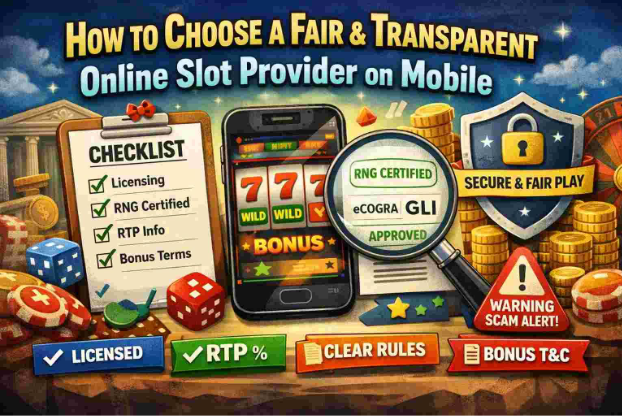
Checklist: How to Choose Fair & Transparent Online Slots (Must-Check)
Here’s a practical checklist to use before depositing—especially on mobile.
1) Check Licensing & Regulation (If Claimed, Verify It)
If a platform claims it’s “licensed,” don’t stop at a logo. Look for:
- the regulator name
- a license number
- the licensed company name
- the registered domain
Then verify it on the regulator’s official license directory (often called a “licensee register”). Red flags include:
- no license number,
- frequent domain changes,
- unclear company details.
Why it matters: In regulated markets, operators typically must meet auditing requirements, consumer protection rules, and formal complaint processes.
2) Look for Proof of RNG Certification / Independent Testing
Fairness depends on RNG that’s tested and on audited release processes. On “About,” “Fairness,” or “Security” pages, look for wording like:
- “independently tested”
- “RNG certified”
- “audited”
Examples of testing labs commonly referenced in the industry (for your awareness): eCOGRA, iTech Labs, GLI, BMM Testlabs.
What matters is not the logo—but whether they provide:
- a specific certificate/statement (ideally with details),
- a date (very old certificates with no updates are suspicious),
- a clear scope (what exactly was tested: RNG, specific games, platform components?).
Red flag: “100% fair” claims with no third-party evidence.
3) Make Sure RTP Info Is Easy to Find (and Understand)
RTP (Return to Player) is the theoretical long-run return percentage. It is not a promise for your session, but it’s a transparency signal.
Check:
- RTP shown in the game info/paytable/help
- whether it states that RTP may vary by region/operator (this can happen)
If you cannot find RTP or basic game info at all, treat that as a red flag.
4) Read the Game Rules: Paytable, Features, and Limits
Before you play, open the paytable and “info” section:
- how wild/scatter works
- free spins/bonus rules
- whether there’s a buy feature and its terms
- min-max bet limits
- special symbol behavior (e.g., multipliers)
Transparent providers present these clearly. If the game info is minimal and mostly marketing, be cautious.
5) Check Bonus & Withdrawal Rules (Most Common Pain Point)
If you use bonuses, read the terms that often cause disputes:
- wagering requirement (how many times you must roll over)
- max bet during bonus (violations can void winnings)
- game contribution (not all games count 100%)
- maximum withdrawal limits from bonuses/free spins
- bonus cancellation/forfeit rules
Fair operators usually make these easy to find and clearly written.
Red flag: vague, changing, or hidden bonus/withdraw terms.
6) Review Mobile Account Security
Mobile play increases phishing and fake-app risk. Look for:
- HTTPS and consistent domains
- 2FA/OTP options
- reasonable privacy/security policies
- apps from official sources (Play Store/App Store). If APK is required, check reputation and app permissions carefully.
Red flag: the app requests excessive permissions (e.g., SMS/contacts without a good reason) or you’re pushed to install from random links.
7) Check Reputation & Customer Support (So You Have an Exit Route)
Before depositing:
- search reviews with keywords like “withdrawal problem,” “bonus void,” “account closed”
- test live chat/email for response quality
- look for formal complaint or dispute resolution paths (common with more serious operators)
No system is perfect, but good operators have process and track record.
Warning Signs You Should Avoid
If you see several of these, it’s safer to walk away:
- aggressive claims like “guaranteed win,” “can’t lose,” “sure-win patterns/time slots”
- licensing info is missing or not verifiable
- no RNG audit proof / only logos with no details
- vague bonus/withdraw terms that can be used to deny payouts
- frequent domain changes, messy site, suspicious pop-ups
Quick Summary (Screenshot-Friendly)
60-second checklist before playing mobile slots:
- Verifiable license (if claimed)?
- Proof of RNG testing by an independent lab?
- Clear RTP + game rules?
- Transparent bonus & withdrawal terms?
- Solid account security (HTTPS, 2FA)?
If 2–3 of these are unclear, don’t deposit.
FAQ
1) What is RNG in online slots?
RNG (Random Number Generator) is the system that randomizes slot outcomes. Each spin is random and not dependent on previous spins.
2) Is there a slot technique that guarantees wins?
No. Because outcomes are RNG-based, there’s no guaranteed-win technique. What you can do is choose transparent platforms and manage risk (budget/time limits).
3) How do I check if an online slot is fair?
Look for verifiable licensing (if applicable), third-party RNG testing, clear RTP and game rules, and transparent bonus/withdrawal terms.
4) Does higher RTP mean I will win?
Not necessarily. RTP is a theoretical long-run average; short sessions can vary widely.
5) What does a trustworthy slot provider look like?
Typically: clear game rules, accessible RTP info, and—in many ecosystems—evidence of independent RNG testing/certification.
Closing
If you’re searching for “slot techniques,” the most realistic shift is toward choosing fair platforms: verifiable licensing, RNG testing, clear RTP/rules, and transparent bonus/withdraw policies. This won’t make you “guaranteed to win,” but it reduces the risk of being scammed and supports safer play.