
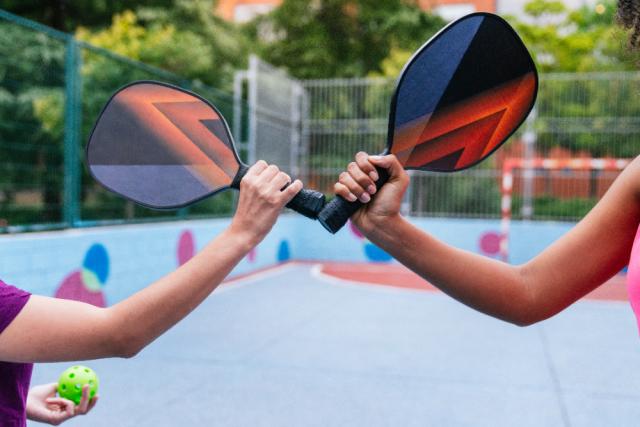
Picking a pickleball paddle feels straightforward until you’re staring at a wall of options with no clear way to separate them. A good pickleball paddle comparison goes beyond the box specs — weight, core material, face type — and digs into how each paddle actually performs in your hand. This guide answers the questions players ask most, so you can make a confident, informed decision before you buy.
What Should You Look at When Comparing Pickleball Paddles?
Start with the traits that directly affect how the paddle plays, not just how it looks on a spec sheet.
Power vs. Control — Do you want a paddle that drives the ball hard, or one that gives you precision at the kitchen line? These two qualities sit at opposite ends of a spectrum. A paddle built for power will typically sacrifice some touch; a control-first paddle will ask you to generate your own pace.
Swing Weight — This tells you how fast your hands can move. A lower swing weight means quicker hands in fast exchanges at the net. A higher swing weight gives you more momentum behind each shot, but your reaction time suffers slightly.
Twist Weight — This is the one most players overlook. Twist weight measures how much the paddle face rotates when you make off-center contact. A higher twist weight means the paddle stays stable on mishits. For developing players, this is one of the most important numbers to check.
Core Thickness — Thicker cores (around 16 mm) produce longer dwell time, which improves control and feel. Thinner cores (around 14 mm) return the ball faster with a livelier response. Neither is universally better — it depends on your playing style.
Spin — Face texture determines how much grip the surface has on the ball. More texture means more spin potential, which matters if you play with heavy topspin or slice.
What Are the Most Common Paddle Comparison Questions?
Is a standard shape or elongated paddle better?
Standard shapes offer a wider face and a more forgiving sweet spot, which suits all-court play and beginners. Elongated paddles extend your reach and concentrate power through a narrower hitting zone, making them popular with singles players and those who like driving from the baseline. The best approach is to compare the same model in both shapes and look at how the swing weight and sweet spot size change between the two.
Does face material make a real difference?
Yes, but the difference is more nuanced than most marketing suggests. Carbon fiber faces tend to generate more spin and have a crisper feel. Fiberglass faces are generally softer and more forgiving. If spin is central to your game, face material is worth prioritizing. If you value touch and consistency, look beyond the face and focus on core construction.
How do you compare paddles across different brands?
The challenge with cross-brand comparisons is that each manufacturer uses its own language and scoring systems. The most reliable method is to find a tool that normalizes performance traits across paddles — one where a control score of 90 means the same thing regardless of which brand built the paddle. That kind of standardized measurement removes the marketing noise and lets you compare apples to apples.
Do higher-priced paddles always outperform budget options?
Not necessarily. Price tends to reflect build consistency and the quality of materials used, but it does not guarantee better on-court performance for every player. Several mid-range paddles measure closely against flagship models on the traits that matter most. A direct, trait-by-trait comparison often reveals that the performance gap is smaller than the price gap suggests.
Where Can You Run a Reliable Paddle Comparison?
Every score is normalized, so comparisons are consistent across the entire database of over 130 paddles. No account required. No manufacturer copy. Just measured data.